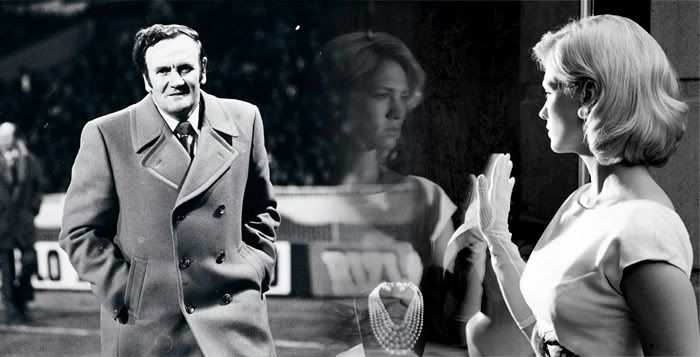
Starting in 2008, I've been keeping track of all the movies and books (sometimes television) that I watch/read in a year. And as of yet, 2010 has been the most representative of turtle-pace consumption of television/movies but the highest in literature reading. Anyhow, the case is that I haven't been watching many films because I find myself pretty much narcoleptic even more so nowadays compared to the time I could sit through the entirety of
Gone with the Wind or
Il Gatttopardo without going through a series of unconscious head bobs. Instead, I am back to the cycle of television series catching--and this time, in the form of
Mad Men.
I love watching it, seeing references, reading on Slate/Guardian's commentaries, and then moving on with life because God knows how much time I actually have when I'm not conking/conked out. But I think my utter favourite pop cross-cultural reference to this date is the nifty article written by Christopher Mann called
"THE MUTUAL SUFFERENCE OF DON REVIE AND BETTY DRAPER" I am not so keen though, on the physical attraction of Betty Draper in correlation to Don Revie's blotchy, skin-sagging, once-had-a-structure, face; it frankly makes me snort in response.
Mad Men meets football manager? What is this supposed crazy spewing of rhetoric, analytically thought out and sitting on the borderline of acceptance on my part? For those who don't know Don Revie, perhaps you've watched The Damned United. And if you haven't watched The Damned United, then in short, Revie is the infamous manager of Leeds United during the 60s and 70s, who, through argued-contradictory/hypocritical play, brought the team to top standing in the league, only to be brought down by his rival (probably because of his argued-contradictory/hypocritical mangement), Brian Clough. And Betty, is the psychologically-afflicted trophy wife of once-Draper and now-Francis, and still engaging in a furious love/hate debacle with her former husband.
Appearances aside, Mann comes to the conclusion that both of these personalities strive to appear and be more sophisticated than others when they are sadly deluded as they fall victim to the same cycle of moral corruption of those who they despise and criticize. (On the other hand, the analogy of Betty Draper-now-Francis/Don Draper antagonism and Don Revie/Brian Clough antagonism insinuates a sort of jealous homoerotic relationship between the latter group, which is half-disturbing and half-comical.) What also helps in concreting the comparison of unlikelihood is the fact that Don Revie's career pretty much teeters on the same time period of Betty's fictional existence. Brilliance right?